
Students Map Urban Tree Canopy for East Portland Equity Initiative
A team of Meridian high school students spent fall semester analyzing Portland's urban tree canopy and its relationship to neighborhood demographics and climate resilience—and their findings are already influencing city policy.
The Project
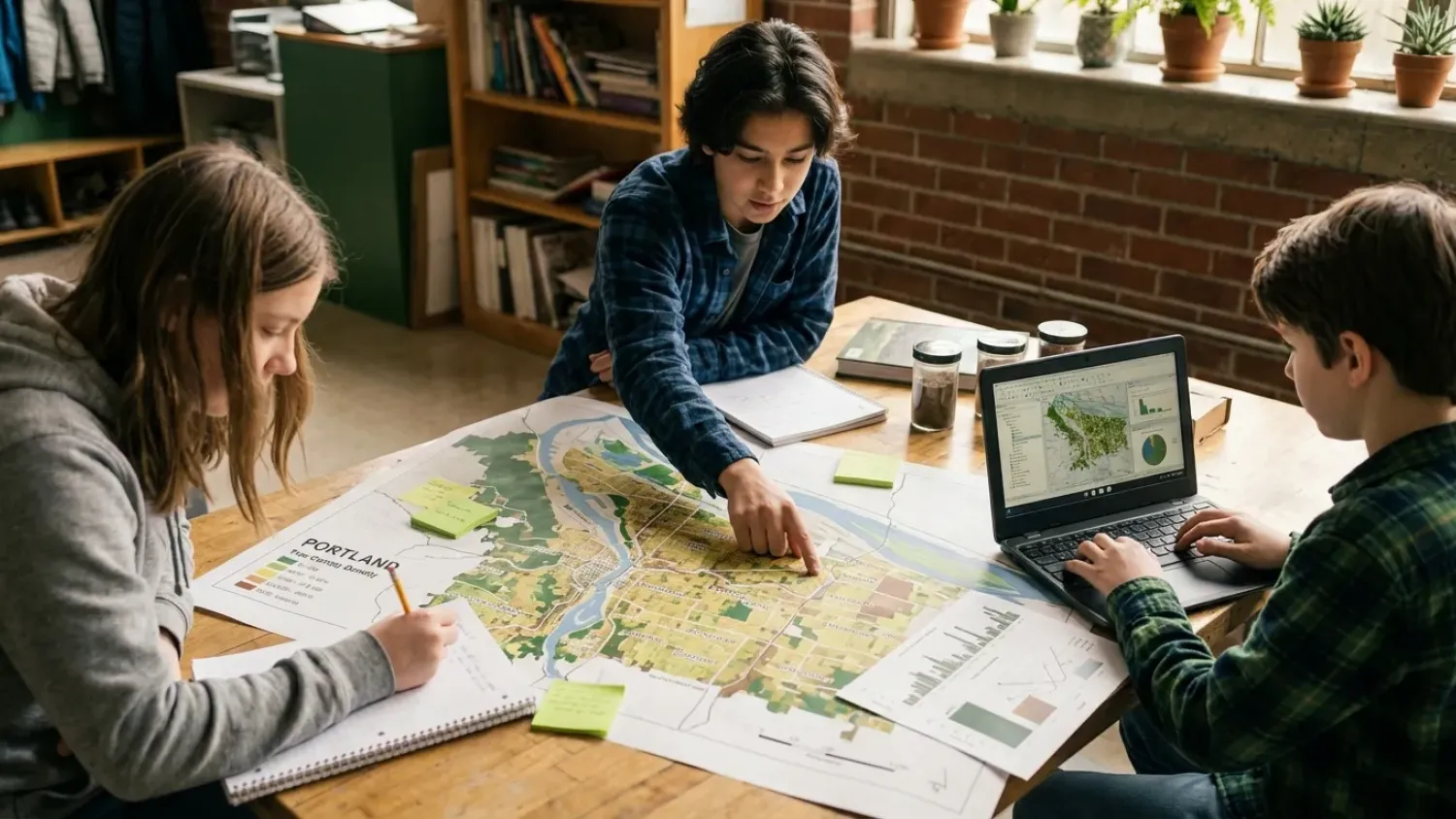
The Urban Tree Equity Project began as an interdisciplinary unit combining environmental science, data analysis, GIS mapping, and policy research. Students wanted to understand why some Portland neighborhoods feel cooler and greener than others, and what that means for equity and climate adaptation.
Working with open data from Portland Parks & Recreation, the Urban Forestry Commission, and the U.S. Census, students created detailed maps showing tree canopy coverage across the city. They overlaid this data with demographic information, temperature readings, and public health indicators.
What They Found
The results were stark. East Portland neighborhoods—which are home to the city's most diverse and lowest-income populations—have 15-20% less tree canopy coverage than wealthier westside neighborhoods.
This disparity has real consequences:
- Higher summer temperatures (up to 10 degrees difference on extreme heat days)
- Poorer air quality
- Fewer community gathering spaces
- Less stormwater absorption, leading to flooding
- Lower property values and decreased neighborhood investment
"We knew intuitively that East Portland felt different," said senior Maya Rodriguez, one of the project leads. "But seeing it quantified in the data was powerful. This isn't just an aesthetic issue—it's a public health and climate justice issue."
Presenting to City Council
In December, the student team presented their findings to Portland City Council during a public hearing on the city's Urban Forestry Management Plan.
Their presentation included:
- Interactive maps showing tree canopy distribution
- Resident interviews highlighting the lived experience of heat and lack of shade
- A cost-benefit analysis of tree-planting investments
- Specific policy recommendations focused on East Portland
The students proposed a targeted tree-planting initiative prioritizing schools, parks, and transit corridors in underserved neighborhoods. They also recommended that the city establish a tree equity fund supported by new development fees.
Commissioner Ranjani Patel called the presentation "one of the most compelling pieces of public testimony I've heard this year."
"These students did the work," Patel said. "They identified a problem, gathered evidence, and proposed solutions. This is exactly the kind of civic engagement we need."
Real-World Impact
The students' recommendations are now being incorporated into the city's 2026 Urban Forestry Management Plan, which will be finalized in March.
Portland Parks & Recreation has also invited the students to serve on a youth advisory committee that will guide implementation of the tree equity initiative over the next five years.
For the students, the experience demonstrated that their learning can have tangible impact beyond the classroom.
"We were nervous going into the City Council meeting," said junior David Nguyen. "But we knew our research was solid, and we knew we were speaking up for communities that don't always have a voice in these decisions. That gave us confidence."
The Learning
The project exemplifies Meridian's approach to education: rigorous, purposeful, and connected to real-world challenges.
Students developed technical skills in GIS mapping, data analysis, and policy research. They also practiced public speaking, collaboration, and advocating for change.
But perhaps most importantly, they learned that they have agency—that young people can contribute meaningfully to the issues shaping their city.
"We talk a lot at Meridian about education as orientation," said Dr. Jameson Reed, Director of Curriculum. "This project is a perfect example. Students weren't just learning about urban forestry or environmental justice in the abstract. They were learning how to navigate a complex civic issue, how to make their voices heard, and how to contribute to solutions."
What's Next
The students plan to continue the project in spring semester, partnering with Friends of Trees and the East Portland Action Plan to support community tree-planting events.
They're also developing educational materials to share their findings with middle school students and community groups across Portland.
"This project showed us that data isn't neutral," Maya reflected. "The numbers tell a story about who has access to green space and who doesn't. We wanted to make that visible—and to do something about it."
Learn more about Meridian's project-based curriculum on our Academics page.